Analogue Heart in a Digital World: Designing the Workplace Like It’s 1965

A phrase that stuck
“Analogue heart in a digital world.” I heard that phrase several years ago and it has stayed with me ever since. At the time it felt like a gentle observation about people who still preferred handwritten notes and vinyl records, but I now think it describes something much bigger that is going to play out at an accelerated pace over the next few years.
We have spent the better part of two decades moving our lives onto screens. We shop, bank, socialise, learn and increasingly work through devices, and the pandemic years pushed that shift further and faster than anyone expected. The convenience has been extraordinary, but so has the cost, and many of us are noticing a quieter, more isolated way of living that we never really chose.
I believe we will naturally find ourselves pushing back against that, not by abandoning technology, but by placing a much higher value on the things it cannot replace: being in the same room, reading a face, sharing a laugh, and building trust the old-fashioned way.
Designing business like it’s 1965
So I was struck to hear Gary Vaynerchuk (Gary Vee) predict, in a recent episode on his GaryVee Video Experience channel titled “The Business GaryVee is Betting on in the AI Era”, that people will start designing their businesses like it’s 1965. His point, as I understood it, is that as more of what we see and hear becomes automated and AI-generated, the human, personal and analogue touches become the real differentiators.
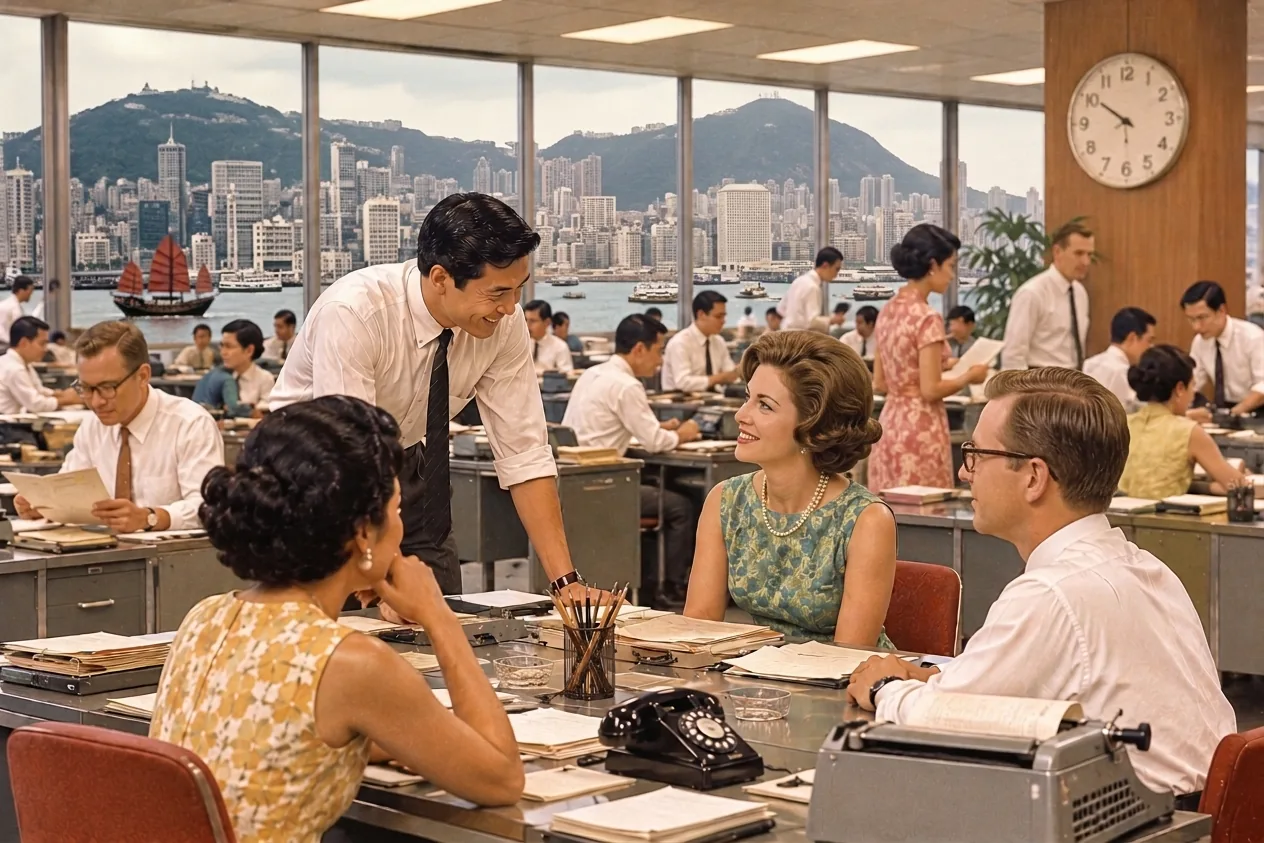
If he’s right, it raises a fascinating question for those of us who work in and around workplace design. If business is heading back to 1965 in spirit, what does designing a workplace for 1965 actually look like?
The cubicle myth
Most people’s first instinct would be to picture rows of cubicles, but 1965 wasn’t a world of cubicles at all. The cubicle arrived in the late ’60s, when Robert Propst and Herman Miller launched Action Office II in 1968, and the sea of partitioned workstations we picture today really took hold through the ’70s and ’80s.
In fact, some of the more progressive thinking in office design around that time was heading in the opposite direction. The “office landscape” (Bürolandschaft) concept, which emerged in Germany in the 1950s, arranged desks in open, organic clusters based on how people actually communicated and worked together, rather than on rank or neat grids.
The typical mid-’60s office was largely open plan, with rows of desks, typing pools, the clatter of typewriters and ringing phones, and a constant hum of conversation across the floor. It was noisy, busy and highly social, although I think we can safely leave the cigar and cigarette smoke in the past.
How we got here
It’s worth remembering that Propst never intended the cubicle to become the dreary maze it turned into. Action Office was designed to give people flexibility and more control over their working environment, but as it was adopted at scale it was often reduced to the cheapest, densest layout possible, and the social side of work was the first thing to go.
I saw the next chapter of this story first hand. In the early 2000s I was working in office solutions product development in Australia, where we were developing open desking systems as an evolution away from traditional enclosed cubicles. Australia was a sophisticated, early-adopting market, so we used it to test the thinking before rolling it out across the wider Asia Pacific region.
The lesson from that period was that open plan on its own was never the answer. Taking the walls down without thinking about how people actually work simply traded one problem for another, swapping isolation for noise and distraction. The workplaces that succeeded were the ones designed around behaviour first and furniture second.
What a social workplace needs now
On a serious note, I believe the future of the workplace is absolutely social, and the design, furniture and fittings we specify will be expected to support that. If people are going to make the effort to come in, the office has to give them something they cannot get at home.
That will likely mean less space given over to rows of individual desks and more to places where people gather, collaborate, learn from one another and simply enjoy each other’s company. It will also mean taking the lessons of the last 20 years seriously, because a social office still needs places to focus, acoustic privacy for calls, and a range of settings that let people choose how they work through the day.
The materials and finishes will matter too. Natural textures, warmer lighting and furniture that feels crafted rather than mass produced all speak to that analogue heart, and I expect clients to ask for more of them as they look for ways to make their spaces feel genuinely human.
The next ten years
I think the next 10 years will be genuinely fascinating for anyone working in this industry. As AI changes the way we work, organisations will have to rethink not just how much office space they need, but what they actually need it for.
Perhaps the irony is that after decades of increasingly sophisticated workplace technology, we will find ourselves rediscovering something that was always there: the value of people being together.
The answer probably won’t look exactly like 1965, but I suspect the best workplaces of the future will borrow something from that era: a little more noise, a little more conversation, and a lot more human connection.
Andy Willett
Founder of re-search, writing on leadership, sales and the workplace industry across Asia Pacific.