![The [RE]Search Co.](https://re-search.co/wp-content/uploads/2025/02/The-RE-Search-Co-Orange_Grey-png-350x51.avif)

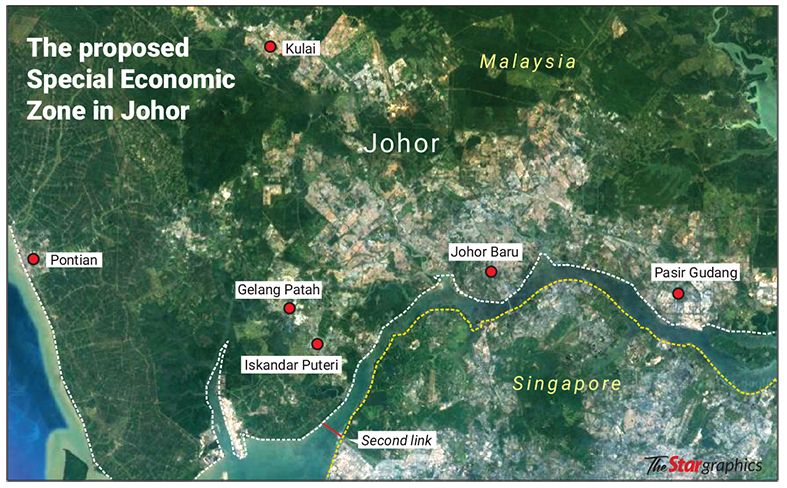
The proposed Johor-Singapore Special Economic Zone (SEZ) has sparked eager anticipation and curiosity in the business community. As Malaysia aims to create the “Shenzhen of Southeast Asia,” this development is poised to significantly impact Corporate Real Estate in both Singapore and Johor Bahru. With its strategic location, favourable policies, and proximity to Singapore, the Johor-Singapore SEZ is expected to attract businesses seeking to leverage its advantages.
Shenzhen, China’s economic powerhouse, transformed from a small rural economy to a global industrial hub in just a few decades. Similarly, the Johor-Singapore SEZ is expected to become a significant economic driver in the SEA region. This new zone will likely attract businesses seeking to leverage its strategic location and proximity to Singapore.
Implications for Corporate Real Estate:
1. Increased demand for office and industrial space in Johor Bahru: As companies flock to the SEZ, demand for modern, high-quality office and industrial spaces will surge. This could lead to a development boom, with new projects and infrastructure emerging to support the growing business community. Developers and investors are likely to capitalise on this opportunity, leading to a surge in construction and investment activity.
2. Enhanced connectivity and collaboration between Singapore and Johor Bahru: The SEZ will foster closer ties between the two cities, potentially leading to increased demand for cross-border office spaces, co-working facilities, and shared services. This could result in the emergence of new business districts and hubs, catering to companies seeking to benefit from the proximity and synergies between the two cities.
3. A Shift in Singapore’s Corporate Real Estate landscape: As some businesses relocate or expand into Johor Bahru, Singapore may experience a shift in demand for office and industrial spaces. This could lead to a more competitive market, with landlords and developers adapting to changing needs and preferences. Some areas in Singapore may experience a surge in demand, while others may need to reinvent themselves to remain attractive.
4. Opportunities for innovative and sustainable developments: The SEZ presents a chance for developers to create cutting-edge, eco-friendly buildings and communities, showcasing the latest in smart city technologies and sustainable design. This could lead to the emergence of new benchmarks for sustainable development, setting a high standard for future projects in the region.
5. Talent attraction and retention: The Johor-Singapore SEZ will likely draw talent from across the region, potentially creating a more competitive labour market. Corporates may need to adapt their real estate strategies to attract and retain top talent, potentially incorporating amenities and services that cater to the needs of a highly skilled and mobile workforce. It also has the potential to reduce the opportunity disparity between Singapore and Johor by creating more local opportunities for Johor residents vs being drawn to Singapore for higher salaries; mostly driven by the currency exchange rate.
6. Infrastructure development and transportation links: The SEZ will require significant investments in infrastructure, including transportation links, utilities, and telecommunications. This could lead to the emergence of new logistics and transportation hubs, catering to the needs of businesses operating in the zone.
7. Impact on local communities: The SEZ will likely have a significant impact on local communities, potentially leading to increased economic activity, job creation, and urbanisation. However, it also raises concerns about gentrification, displacement, and environmental impact.
Potential Investment Risks:
1. Political risks: The SEZ is a joint initiative between Malaysia and Singapore, and any changes in political relations or policies could impact the zone’s development and attractiveness.
2. Economic risks: The SEZ’s success is closely tied to the economic performance of Singapore and Malaysia. Economic downturns or trade tensions could impact investor confidence and demand for space.
3. Regulatory risks: The SEZ will be subject to a complex regulatory framework, and any changes or inconsistencies could impact businesses operating in the zone.
4. Currency risks: The SEZ will likely attract foreign investment, and currency fluctuations could impact the attractiveness of the zone and the profitability of businesses operating there.
Historical Lessons:
1. Previous attempts to develop Johor Bahru as a manufacturing hinterland for Singapore have faced challenges, including a lack of infrastructure, skilled labor shortages, and bureaucratic red tape.
2. The 1997 Asian financial crisis and the 2008 global financial crisis impacted investor confidence and economic growth in the region, highlighting the need for robust risk management and economic resilience.
3. Environmental concerns and social impact assessments will be crucial in the development of the SEZ, as the zone’s success will depend on its ability to balance economic growth with social and environmental responsibility.
Overall, the Johor-Singapore SEZ has the potential to influence the Corporate Real Estate landscape in both Singapore and Johor Bahru. While there are risks and challenges to be addressed, the zone’s strategic location, favourable policies, and proximity to Singapore make it an attractive opportunity for businesses and investors, including the Corporate Real Estate sector.