![The [RE]Search Co.](https://re-search.co/wp-content/uploads/2025/02/The-RE-Search-Co-Orange_Grey-png-350x51.avif)
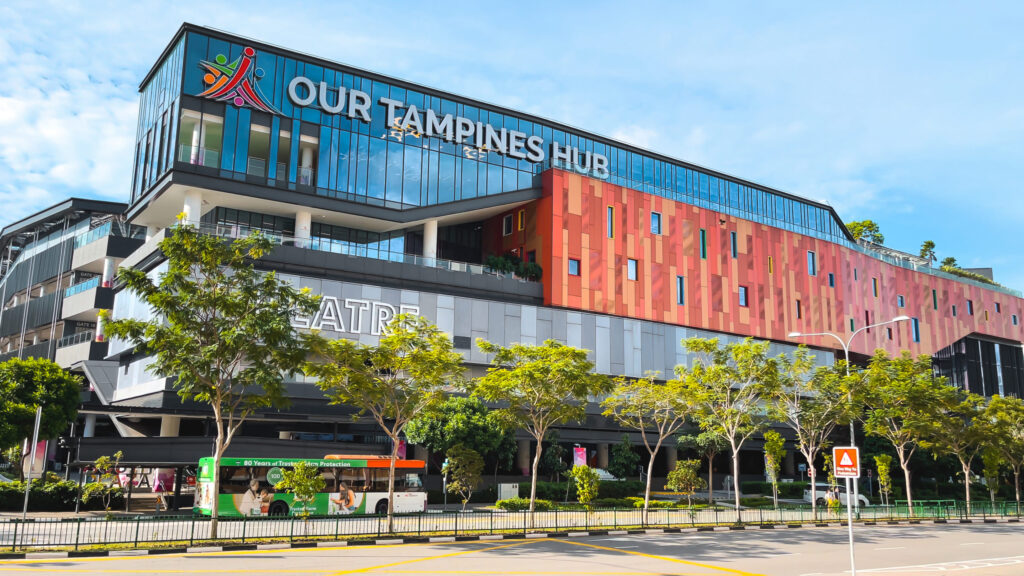
There was a very interesting article in Singapore’s Straits Times this week featuring a groundbreaking analysis that shed light on the significance of connected neighbourhoods, highlighting Tampines as Singapore’s most well-connected regional center.
But what implications does this hold for the wider Asian landscape, especially in the context of evolving work models ad corporate real estate post-pandemic?
Polycentricity and Connected Communities

Tampines, a bustling regional hub in Singapore, showcases the highest degree of polycentricity among regional centers, surpassing Jurong and Woodlands. Polycentricity (a term I just learnt this week), meaning the clustering of various human activities, fosters connectivity, attracting commuters and reducing travel distances for residents. This phenomenon underscores the importance of regional centers in shortening commute times and enhancing quality of life.
An in-depth analysis of Global Positioning System data from residents’ mobile phones reveals compelling insights, although perhaps also some big-brother tendencies.. But it showed that residents of Tampines, on average, travel the shortest distances from home to their destinations, epitomising connected communities. Conversely, the residents of Woodlands, another Singapore neighbourhood embark on longer journeys, indicative of lower polycentricity. And interestingly, during the stringent social distancing measures amid the Covid-19 pandemic, Tampines witnessed the most significant reduction in travel distances, underscoring its resilience and adaptability.
The Future of Work: Hybrid Models and Neighbourhood Connectivity
As the world continues to navigate a post-pandemic reality, the future of work undergoes a paradigm shift, with hybrid models seemingly emerging as frontrunners. We know that the pandemic served as a catalyst for reimagining traditional office spaces, prompting organisations to embrace flexibility including remote work arrangements in many cases. However, the resurgence of office attendance post-pandemic does raise pertinent questions about the sustainability of remote work.
The discussion extends beyond mere workplace arrangements; it delves into the fabric of connected neighbourhoods. Mr. Chiu Wen Tung, from Singapore’s Urban Redevelopment Authority, underscores the need for effective hybrid arrangements that balance productivity and cohesion. So the integration of connected neighbourhoods into hybrid work models emerges as a pivotal consideration. Neighbourhoods like Tampines, with their robust infrastructure and vibrant community spirit, exemplify the potential of fostering collaboration and connectivity in support of a broader hybrid work environment.
Urban Revitalisation and Post-Crisis Recovery
Beyond the realm of work, urban revitalisation and post-crisis recovery assume paramount importance in shaping the urban landscape. Singapore’s property data unveils the enduring relevance of physical offices, particularly in city centers. While the industrial composition of office tenants undergoes a transformation, global technology firms gravitate towards central business districts, underscoring the resilience of urban hubs.
Interestingly, a chapter in the book delves into cities’ recovery post-disaster, drawing parallels across Singapore, Hong Kong, Taipei, New York, Paris, and London. Noteworthy similarities emerge, emphasising governments’ emphasis on reviving tourism, and supporting small and medium-sized enterprises. These insights underscore the pivotal role of urban planning in helping to navigate crises and fostering sustainable urban ecosystems.
Towards a Connected Asia
As Singapore continues in its quest for urban innovation, the broader Asian landscape stands poised to embrace the future of connected neighbourhoods. The success of regional centers like Singapore’s Tampines serves as a potential blueprint for polycentricity and community cohesion. In the era of hybrid work models, the integration of connected neighbourhoods assumes newfound significance, transcending geographical boundaries and promoting collaboration.
So we can likely conclude that the journey towards urban revitalisation and sustainable development could hinge upon embracing connectivity and community-centric planning. As Asia charts its course, the role of connected neighbourhoods emerges as a key component in resilience, innovation, and inclusive growth.
Through continued efforts and visionary ‘polycentric’ urban planning, Asia can certainly unlock further potential in regional connectivity, outside of the traditional city centres.