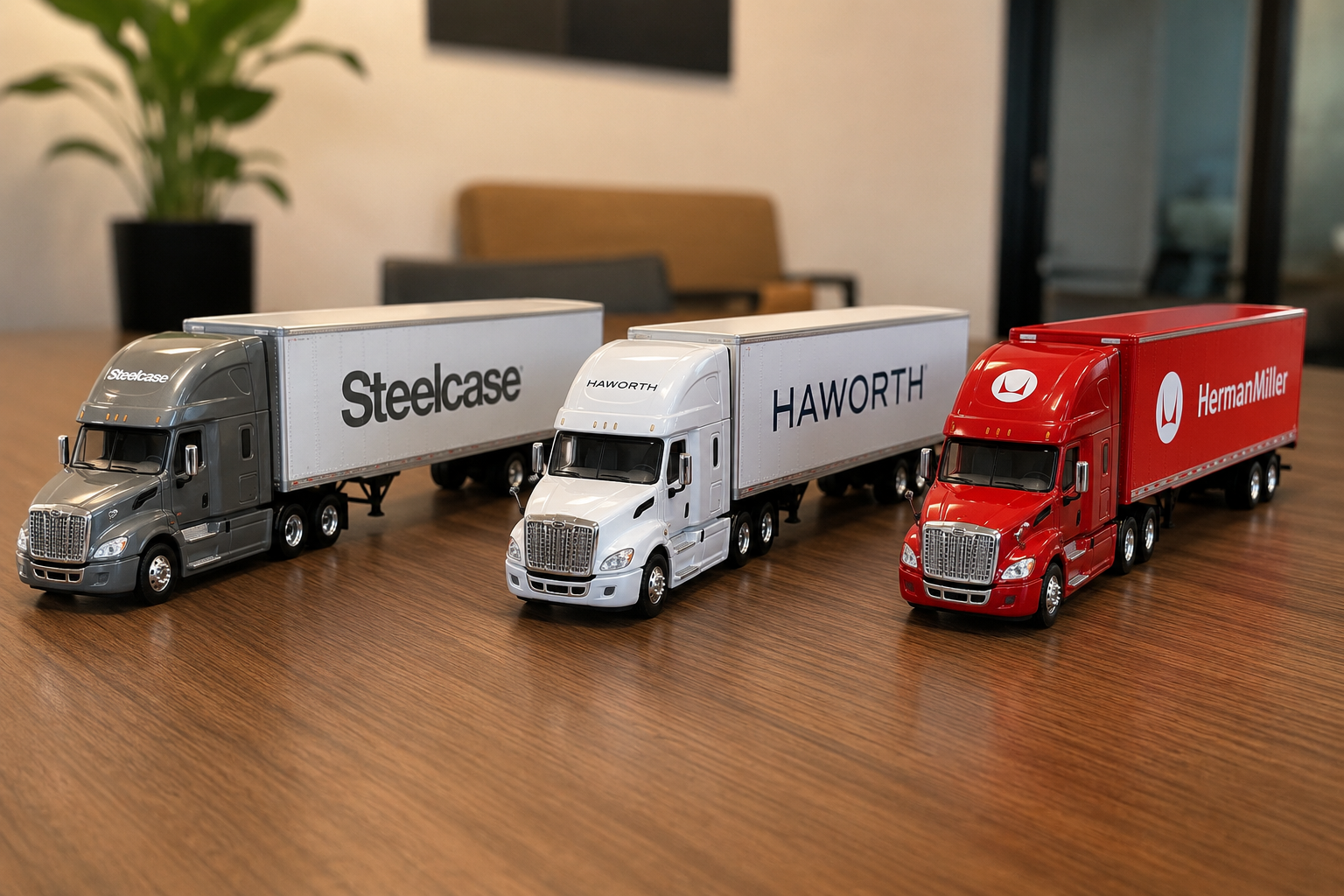
If you think Haworth, MillerKnoll or the newly-combined HNI/Steelcase have distribution figured out, look closer. Even at that scale, with decades of category leadership behind them, getting go-to-market right in the contract furniture and interiors space remains an unsolved problem, one they keep revisiting, market by market, cycle by cycle.
The HNI-Steelcase merger, completed in December 2025, is itself a distribution story as much as a product one. Bringing two major dealer networks and brand portfolios under one roof doesn’t just add scale, it forces a hard look at overlapping dealer territories, brand positioning, and go-to-market structure across every region both companies operate in. Consolidation at that level is a reminder that distribution strategy isn’t a background decision. It’s often the whole point of the deal.
Dealer-led vs. direct: a US/Asia divide that’s more nuanced than it looks
The US model has traditionally leaned dealer-led, a mature, deeply entrenched network built up over decades, where the dealer relationship often matters as much as the brand itself.
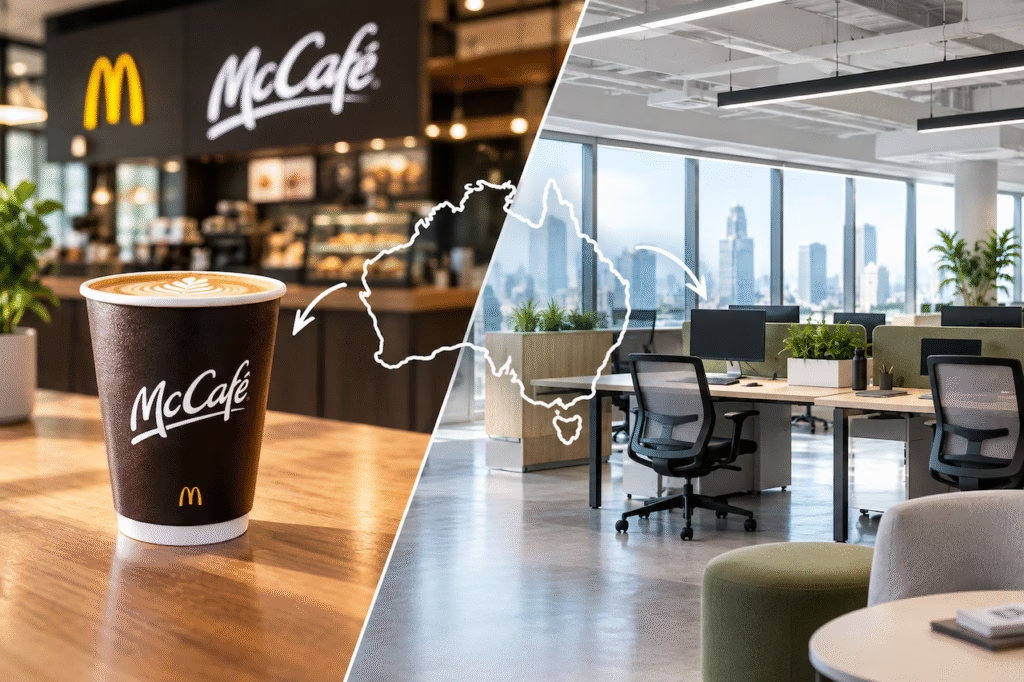
Asia has never been that simple. Across my 30 years working for and with manufacturers, suppliers and dealers in this space, I’ve watched approaches shift market by market, Shanghai, Hong Kong, Singapore, Sydney, Bangalore, each with a different answer depending on maturity, complexity and the state of the local supply chain.
The pendulum swing: control vs. cost
There was a period, particularly in the major regional centres, where owning the customer experience directly was the clear priority for most and seemed to deliver the fastest route to market share. If you wanted consistency of brand, service and delivery, you controlled it yourself.
That calculus has shifted. As cost pressures have mounted, dealer and distributor models have become a lot more attractive, not because manufacturers stopped caring about customer experience, but because the financial risk of carrying that infrastructure directly, especially through turbulent conditions, has become harder to justify.
Maturity brings more options
One thing that’s often missed: as markets mature, the distribution options available actually multiply. Some of the most effective come from a model that’s genuinely “born from within”, former employees, people who once ran the brand’s own market presence directly, stepping out to set up their own dealership and take that same brand forward. It’s a win-win: the manufacturer gets a dealer who already knows the brand, the customers and the market inside out, and the individual gets to build something of their own. What worked as a market entry strategy 15 years ago isn’t necessarily the right structure for that same market today.
Two different costs, not one trade-off
It’s tempting to frame this as “control vs. cost”, as if control is free and only the dealer route carries a downside. It isn’t that simple. Both paths carry a real cost, they’re just different costs.
Handing distribution to a dealer or distributor means giving up a degree of control. Client experience is genuinely harder to manage at arm’s length, and that’s not a hypothetical cost.
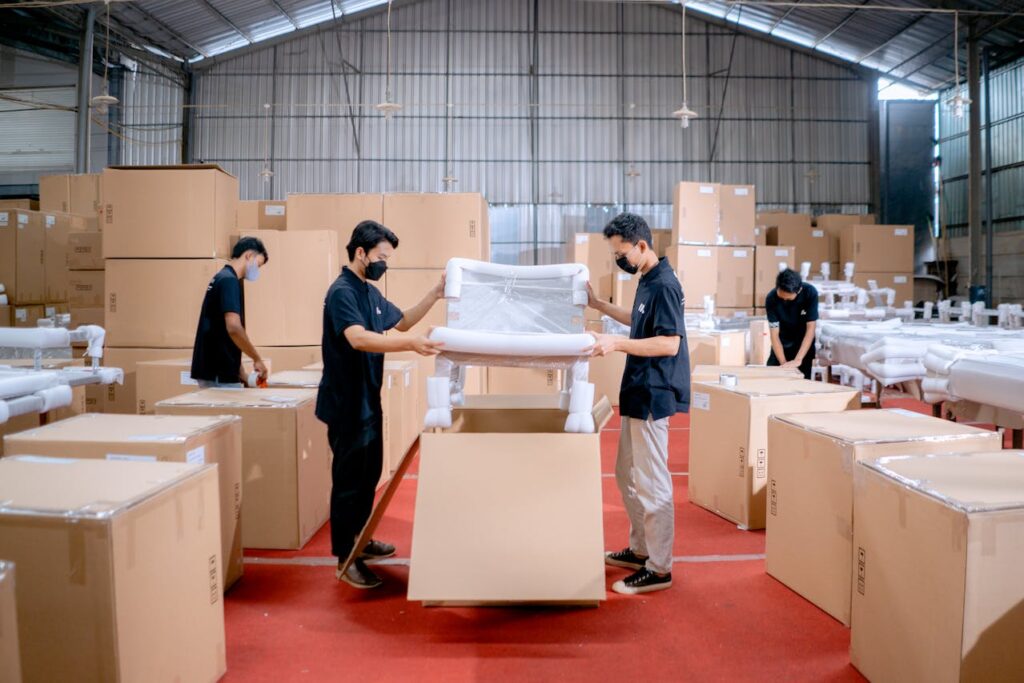
But keeping distribution wholly-owned carries its own cost that rarely gets talked about: headcount. Nobody discusses the hiring that happens through the good times, it’s the quiet, unremarkable part of running your own operation. The cuts, when challenging conditions force them, are a different story. They’re painful, and they come with negative optics that a manufacturer running direct simply can’t avoid. Publicly right-sizing a wholly-owned salesforce or service team is a visible signal to the market in a way that a dealer quietly adjusting its own headcount never is.
Seen this way, the decision isn’t about avoiding cost. It’s about choosing which cost you’re better placed to carry, and when.
Why hybrid is increasingly the answer
In practice, it’s rarely a binary choice. What I see more and more is a hybrid approach, broad market coverage through dealers and distributors, paired with a retained direct presence in-region for oversight, key account management, and staying close to the clients who matter most.
It’s not indecision but a recognition that control and cost don’t have to be an either/or, they can be allocated deliberately, market by market, account by account.
Distribution strategy in this industry isn’t a solved problem you implement once. It’s a live decision that gets revisited as markets mature, conditions shift, and cost pressures change. So the manufacturers getting it right aren’t necessarily the ones with the “correct” model, but they are the ones willing to keep re-examining it.